
Walk into most Indian supermarkets and you'll notice the lighting, the music, the aisles designed to make you linger. Walk into a DMart and none of that is really the point. The stores look almost deliberately plain, the layouts are functional rather than inviting, and yet DMart has built one of India's most profitable retail businesses on exactly that lack of polish. The question worth asking isn't why DMart looks the way it does. It's how looking that way translates into prices customers keep coming back for.
The Basic DMart Business Model
DMart is the retail chain operated by Avenue Supermarts Limited, a company incorporated in 2000 and taken public in 2017, with its first store opening in Mumbai in 2002. The company is majority owned by investor Radhakishan Damani and his family, who together hold roughly 74.5% of the business. By the end of FY26, the fiscal year ending March 31, 2026, DMart had grown to 500 stores spanning around 20.58 million square feet, spread across states including Maharashtra, Gujarat, Telangana, Karnataka, Andhra Pradesh, Madhya Pradesh, Tamil Nadu, Rajasthan, Punjab, the NCR region, Chhattisgarh and Daman.
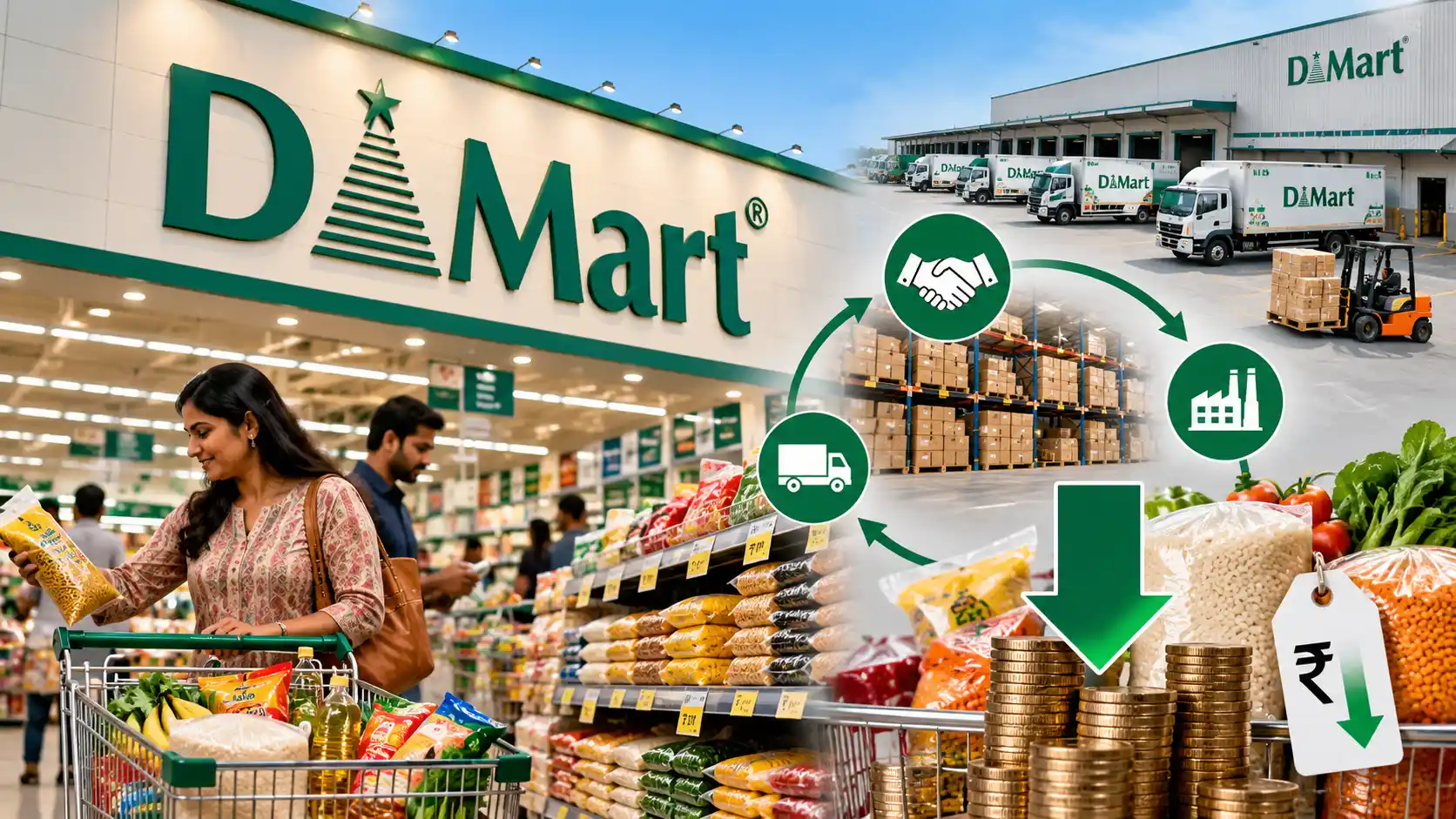
The model itself borrows heavily from Walmart's playbook: Everyday Low Cost, Everyday Low Price, often shortened to EDLC-EDLP. The idea is simple to state and hard to execute. Keep the underlying cost of running the business as low as possible, and pass a meaningful share of those savings to customers through consistently competitive shelf prices, rather than relying on periodic sales or promotional discounting.
How Bulk Buying and Supplier Relationships Work
DMart's scale gives it real leverage with suppliers, though it's worth being precise about what that leverage actually looks like. The company operates a centralized procurement system and buys directly from manufacturers and large traders rather than going through multiple layers of distribution. High store footfall lets it place large, predictable orders, and several industry analyses have pointed to prompt supplier payments, with vendors reportedly paid within about 11 days of delivery, as a factor that earns DMart better terms than retailers who pay more slowly. One analysis has described this dynamic as DMart effectively financing a portion of its suppliers' working capital in exchange for cheaper procurement. This is a plausible and often-cited explanation for DMart's pricing edge, but it comes from industry analysis rather than a disclosed, itemized supplier discount structure published by the company, and it would be inaccurate to claim DMart secures the single lowest price from every supplier on every product.
Cost Control Behind DMart's Pricing
If there's one decision that shapes everything else about DMart's economics, it's the choice to own most of its store properties rather than lease them. Industry estimates put typical retail rent at somewhere between 5% and 7% of revenue for a conventional store. DMart converts a large share of that recurring cost into a one-time capital expense by buying land and buildings outright. As of FY26, around 68 of the company's 500 stores sit on long-term leased land or buildings rather than company-owned property, meaning the large majority, though not all, of the network is owned. Alongside this, DMart keeps its advertising spend minimal and avoids expensive mall locations in favor of standalone buildings, further reducing the fixed costs baked into each store's operations.
Stores, Property and Operating Expenses
DMart's stores are also physically unusual by Indian retail standards. Rather than the smaller, mall-anchored formats common among competitors, DMart stores typically range from around 10,000 to 94,000 square feet, averaging roughly 40,000 square feet, built as standalone, single-floor structures. The company places these either in densely populated areas to capture heavy footfall, or on comparatively inexpensive land on a city's outskirts, where a larger footprint becomes affordable. This is paired with a cluster-based expansion strategy, where DMart saturates a region with stores before moving into new territory, a deliberate choice that keeps logistics and distribution costs manageable even as the overall pace of expansion looks slower than some competitors.
Inventory and Supply-Chain Efficiency
DMart's inventory reportedly turns over roughly 13 to 14 times a year, a rapid cycle that means products move off shelves and get replaced quickly rather than sitting as dead stock tying up cash. Combined with the prompt-payment approach to suppliers described earlier, this creates a cash-generative loop: customers pay immediately at checkout, while the company has more breathing room before it needs to pay vendors, leaving DMart with strong operating cash flow that has historically let it fund store expansion without taking on debt. According to financial data compiled from the company's disclosures, Avenue Supermarts has carried zero total debt across its FY21 to FY25 reporting years, a genuinely unusual position for a business expanding its physical footprint as aggressively as DMart has.
Private Labels and Product Mix
DMart also sells products under its own private-label brands alongside third-party FMCG and grocery items, a common retail strategy that can offer better margins and more control over quality and packaging than reselling established national brands alone. As of the first half of FY26, the company's revenue split across its three broad categories stood at Foods contributing 57.01%, Non-Foods FMCG at 19.65%, and General Merchandise and Apparel making up the remaining 23.34%. Specific, verified margin figures for private-label products specifically were not available in company disclosures reviewed for this article, so this article does not quantify the private-label margin advantage beyond noting it as a general, industry-recognized retail strategy DMart employs.
DMart vs Other Retail and Quick-Commerce Models
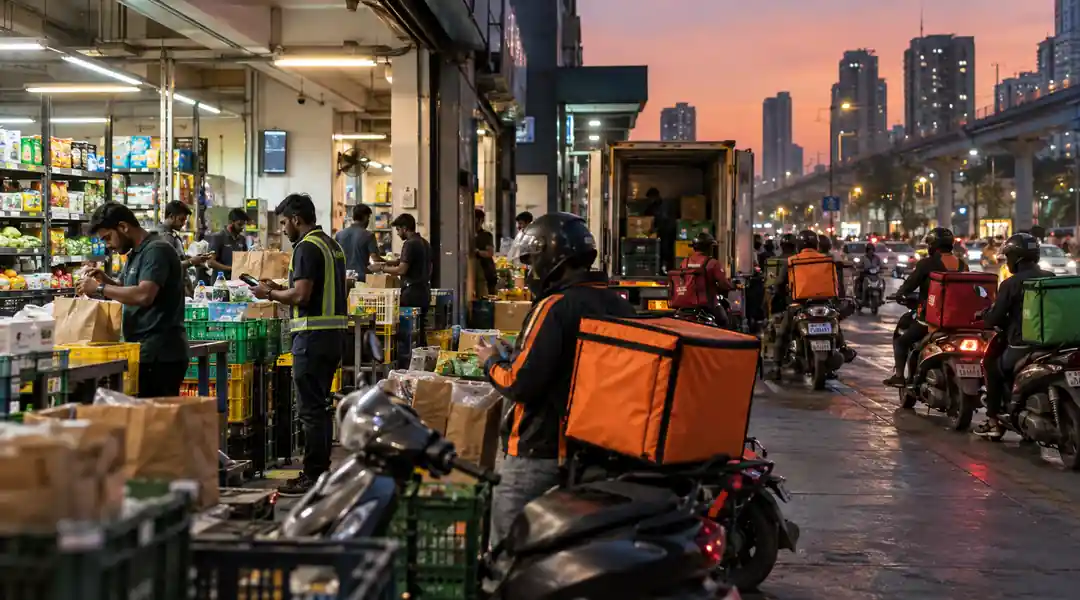
DMart's approach looks quite different from Reliance Retail, which operates a much larger number of considerably smaller stores, often located inside malls or residential complexes, relying on scale through store count rather than large-format, high-footfall outlets. It also stands apart from the quick-commerce model that has grown rapidly in Indian metros, where speed of delivery, rather than the lowest possible shelf price, is the primary value proposition. DMart's own online arm, DMart Ready, has struggled to find the same economics as its physical stores: in FY25, the e-commerce business grew revenue 21% year-on-year to around ₹3,500 crore but posted a pre-tax loss of roughly ₹247 crore, prompting the company to scale back its city coverage from 24 cities to 18 in FY26 and pivot more heavily toward home delivery in major metro areas rather than broad geographic expansion.
| Factor | DMart Approach | Industry Alternative | Business Impact |
|---|---|---|---|
| Store property | Owns roughly 86% of stores outright | Leases most or all retail space | Converts recurring rent into a one-time cost, though owned stores require large upfront capital |
| Store format | Large, standalone, single-floor stores (~40,000 sq ft average) | Smaller stores inside malls or residential complexes | Lower per-store rent exposure but requires larger land parcels and slower rollout |
| Expansion pace | Cluster-based, regional saturation before moving on | Rapid, wide-geography store rollout | Slower headline growth but tighter logistics and distribution costs |
| Supplier payment | Reportedly rapid, near-immediate payment terms | Standard or delayed vendor payment cycles | May support better supplier pricing, though not verified as the lowest price on every item |
| E-commerce | DMart Ready scaled back to fewer cities, loss-making in FY25 | Aggressive quick-commerce expansion | Reflects a deliberate trade-off favoring physical-store economics over online growth |
Financial Performance and Key Numbers
Avenue Supermarts reported FY26 (year ended March 31, 2026) revenue of approximately ₹68,821 crore, up 15.9% from the prior year, with net profit of around ₹2,970 crore. The fourth quarter of FY26 alone saw standalone total income rise about 19% year-on-year to roughly ₹17,235 crore, with EBITDA up 26% to ₹1,232 crore, aided by festive demand and a sharp acceleration in store openings, 58 new stores in that quarter alone, taking the FY26 total to 85 new stores, the company's highest-ever annual addition. Looking at the broader trend, the company's revenue climbed from roughly ₹24,143 crore in FY21 to ₹59,358 crore in FY25, with net profit rising from about ₹1,099 crore to ₹2,707 crore over the same period, alongside a debt-free balance sheet throughout.
Challenges to the Low-Price Strategy
DMart's model isn't immune to pressure. Some brokerages covering the FY26 results flagged that the quarter's strong demand was partly supported by price hikes, store expansion and lower interest costs rather than purely organic volume growth, cautioning that this tailwind may not repeat once conditions normalize. Rising real estate costs in the locations DMart still needs to expand into, competition from quick-commerce platforms in urban grocery delivery, and the ongoing losses at DMart Ready all represent live challenges rather than settled advantages. Inflation in commodity and input costs, along with wage growth for store staff, also weighs on the cost base DMart works to keep lean.
Expert and Industry Views
Reaction to DMart's FY26 results from brokerage analysts was notably mixed, ranging from what one report described as high-conviction outperform calls to at least one sell rating, reflecting genuine disagreement over whether the current pace of store additions and demand growth is sustainable without straining free cash flow. One industry comparison has drawn a pointed contrast between DMart's debt-free, cash-generating structure and the fate of Big Bazaar, once India's dominant value retailer, which ultimately collapsed into bankruptcy, a reminder that scale and popularity alone don't guarantee a retail model's survival.
Conclusion
DMart's low prices aren't the product of any single trick. They come from a set of reinforcing choices, owning rather than renting most stores, buying in bulk and paying suppliers quickly, turning inventory over rapidly, keeping advertising and store decor minimal, and expanding methodically rather than everywhere at once. None of this guarantees DMart has the cheapest price on every item in every city, and the model carries real trade-offs, including a slower expansion pace and a struggling e-commerce arm. But as a structural approach to keeping everyday prices low while staying profitable and debt-free, it remains one of the more distinctive stories in Indian retail, not because any one part of it is unique, but because of how consistently the whole system has been executed over two decades.
Further reading and useful links
Reader questions
Frequently asked questions
What is DMart's core business strategy?
DMart operates on an Everyday Low Cost, Everyday Low Price (EDLC-EDLP) model, keeping operational costs minimal to offer consistently low retail prices.
How does DMart save on real estate costs?
Unlike traditional retailers who lease space, DMart owns the large majority of its store properties outright, converting recurring rent into a one-time capital expense.
What was DMart's financial performance in FY26?
For FY26, Avenue Supermarts reported revenue of approximately ₹68,821 crore, up 15.9% year-on-year, with a net profit of around ₹2,970 crore.
How does DMart handle supplier relationships?
DMart procures centrally and pays vendors rapidly (within about 11 days), which helps secure favorable commercial terms and reliable product supply.
Nexuswild welcomes factual corrections. Email contact@nexuswild.com with evidence and the article URL.