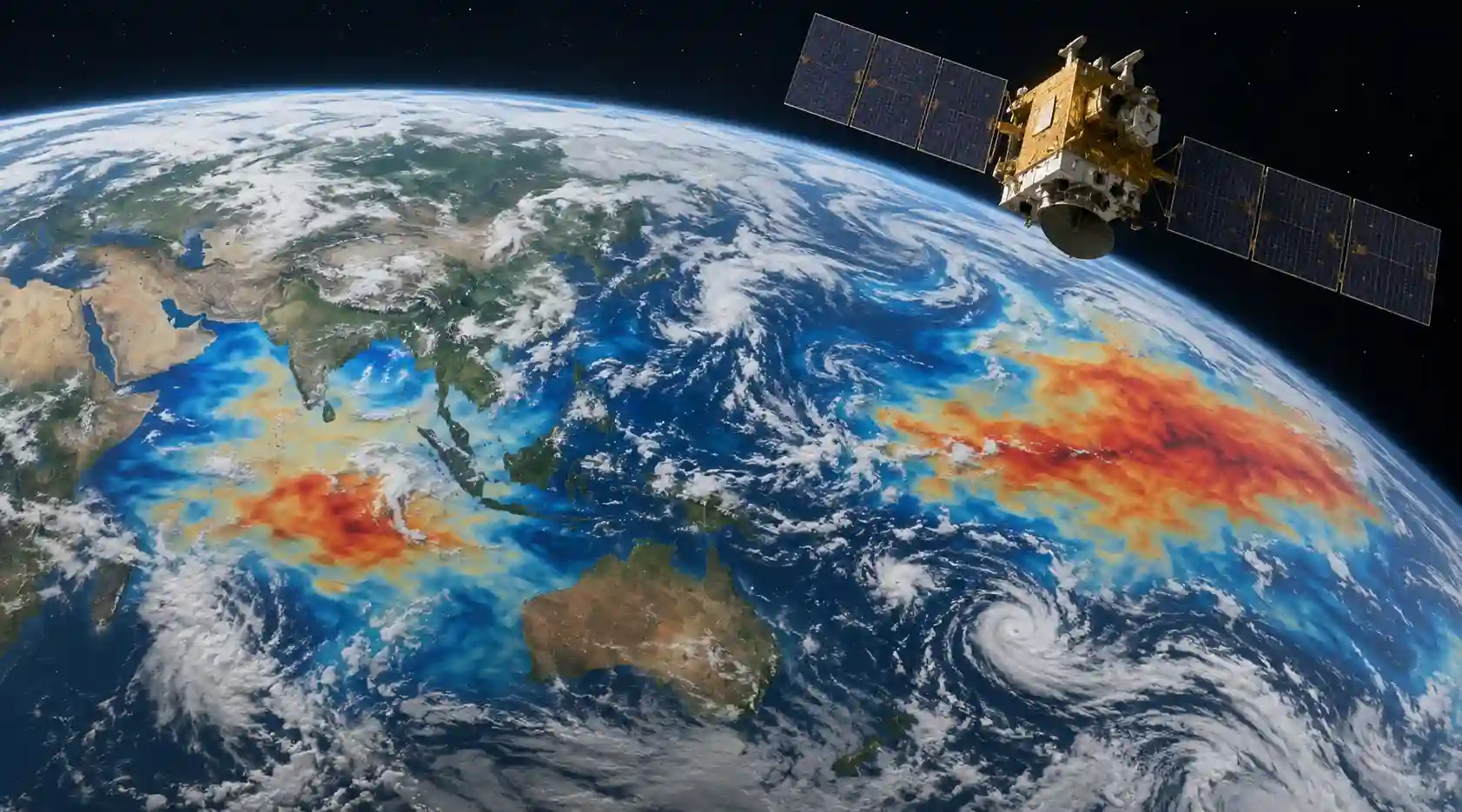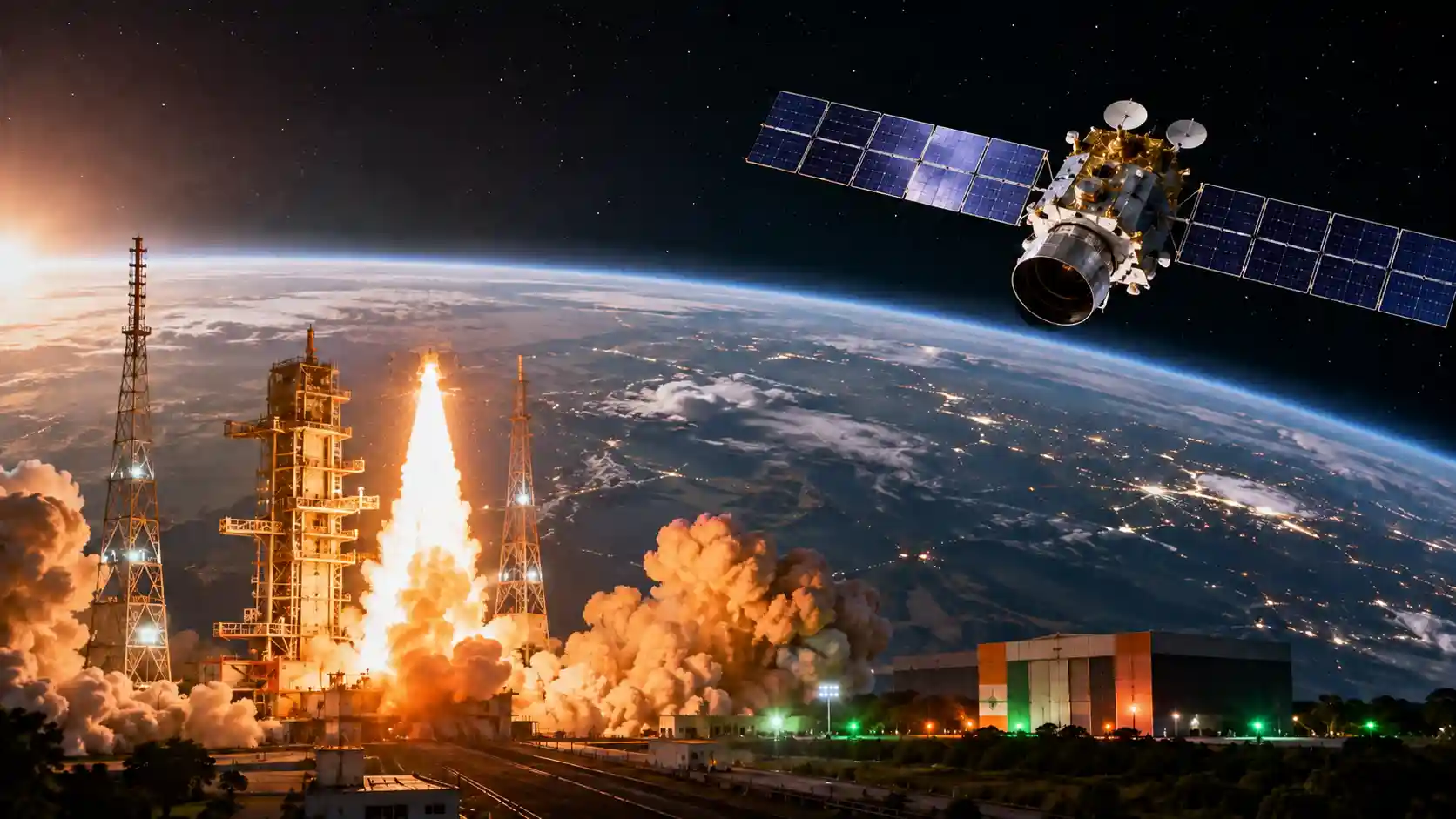

The Indian Space Research Organisation successfully launched EOS-05, its first dedicated Earth imaging satellite designed to operate from geosynchronous orbit, in the early hours of September 4, 2026. The satellite lifted off at 2:55 am IST aboard the GSLV-F17 rocket from the Second Launch Pad at the Satish Dhawan Space Centre in Sriharikota, Andhra Pradesh.
GSLV-F17 was the 19th flight of India's Geosynchronous Satellite Launch Vehicle, a 51.7-metre, three-stage rocket with a liftoff mass of about 420.5 tonnes and a cryogenic upper stage. ISRO said the rocket precisely injected EOS-05 into its intended sub-geosynchronous transfer orbit roughly 18 minutes after liftoff.
That is the first step in the process. The satellite will still need to use its own onboard propulsion over the coming days to raise and circularize its orbit to its final geosynchronous position at an altitude of about 36,000 km, followed by in-orbit checks before its payloads become fully operational.
EOS-05 Becomes Heaviest Satellite Carried by GSLV
At 2,367 kg, EOS-05 is the heaviest satellite GSLV has carried to date. ISRO Chairman V Narayanan said the agency has steadily improved GSLV's performance by optimizing structural mass and propulsion, allowing it to lift heavier payloads than earlier flights.
The launch was the 107th from Sriharikota.
EOS-05 carries imaging systems that operate across visible, infrared, multispectral and hyperspectral bands, allowing it to capture different types of information about land, water, vegetation and atmospheric conditions.
Because it sits in geosynchronous orbit, its orbital period matches Earth's rotation, letting it remain positioned over the same broad region and observe it continuously rather than passing overhead periodically like satellites in lower orbits.
What EOS-05 Will Be Used For
Union Minister of State for Science and Technology Jitendra Singh described EOS-05 as India's first imaging satellite from geosynchronous orbit, intended to support applications such as agriculture and disaster management.
Narayanan also described the satellite as a platform that will generate continuous strategic data once operational, while ISRO has stressed that the satellite should not be characterized simply as a spy satellite, reflecting the dual-use nature common to modern Earth observation systems.
EOS-05 is part of ISRO's broader Earth Observation Satellite programme and follows the agency's earlier attempt to place a similar geo-imaging satellite in orbit.
In August 2021, the GSLV-F10 mission carrying EOS-03, then known as GISAT-1, failed roughly 307 seconds after liftoff due to an anomaly in the cryogenic upper stage. EOS-05 is effectively a rebuilt successor to that mission, and some reports have referred to it informally as GISAT-2.
Seven-Year Operational Life Planned
Narayanan said EOS-05 has an assured operational lifetime of seven years and expressed confidence that it could function for more than nine.
The launch also marks a significant moment for ISRO's recent launch record. It comes after an eight-month gap following the failure of the PSLV-C62 mission in January 2026, when an anomaly in the rocket's third stage prevented its 16 satellites from reaching their intended orbit.
GSLV itself has a mixed history, with six failures across its 19 flights, making Friday's precise injection an important confidence builder for the vehicle.
For India's space programme, EOS-05 represents a step toward sustained, persistent Earth observation from geostationary altitude, a capability distinct from the country's existing fleet of lower-orbit imaging satellites.
Its success does not by itself confirm the satellite is fully operational, since payload commissioning and final orbit-raising are still to come, but the successful launch and orbital injection mark a meaningful recovery for ISRO after a difficult stretch of missions.
Reader questions
Frequently asked questions
What is EOS-05?
EOS-05 is an ISRO Earth observation satellite designed to provide persistent imaging from geosynchronous orbit using visible, infrared, multispectral and hyperspectral instruments.
When was EOS-05 launched?
EOS-05 was launched on September 4, 2026, at 2:55 am IST aboard the GSLV-F17 rocket from Sriharikota.
Why is the EOS-05 launch significant?
EOS-05 is India's first dedicated imaging satellite designed for geosynchronous orbit, allowing more continuous observation of the same broad region than typical lower-orbit imaging satellites.
Is EOS-05 already fully operational?
No. The successful launch placed EOS-05 into its intended transfer orbit, but the satellite still needs to reach its final orbit and complete in-orbit testing and payload commissioning.
How long is EOS-05 expected to operate?
ISRO has stated an assured operational life of seven years, with the possibility that the satellite could remain functional for more than nine years.
Nexuswild welcomes factual corrections. Email contact@nexuswild.com with evidence and the article URL.