
Computing is beginning to move closer to where space data is created
Satellites have traditionally followed a simple computing model.
They collect data in orbit.
They store it temporarily.
They wait until they can communicate with a ground station.
They transmit large quantities of raw information back to Earth.
Only then do terrestrial data centers begin the expensive work of processing imagery, identifying objects, measuring environmental change or extracting other useful information.
Indian space startup TakeMe2Space wants to change that architecture.
Instead of treating a satellite primarily as a sensor connected to computers on Earth, the Hyderabad-based company wants the satellite itself to become a programmable computing platform.
Its next spacecraft, MOI-1A, is scheduled to launch on October 1 aboard SpaceX's Transporter-18 Falcon 9 rideshare mission from California.
TakeMe2Space describes it as India's first commercial orbital computing satellite.
The spacecraft combines Earth-observation imaging with an NVIDIA Jetson Orin NX-based processing system capable of running artificial-intelligence models directly in low Earth orbit.
The objective is straightforward.
Do not send every raw image to Earth.
Process the data where it is captured.
Then transmit the answer.
That seemingly simple change could become increasingly important as satellites generate more data than communications networks can efficiently return to the ground.
MOI-1A is scheduled to launch on October 1
SpaceX currently lists its Transporter-18 rideshare mission for October 1 from Space Launch Complex 4E in California.
MOI-1A is scheduled to ride aboard that mission.
TakeMe2Space says the spacecraft will become the first operational node in its planned orbital computing network.
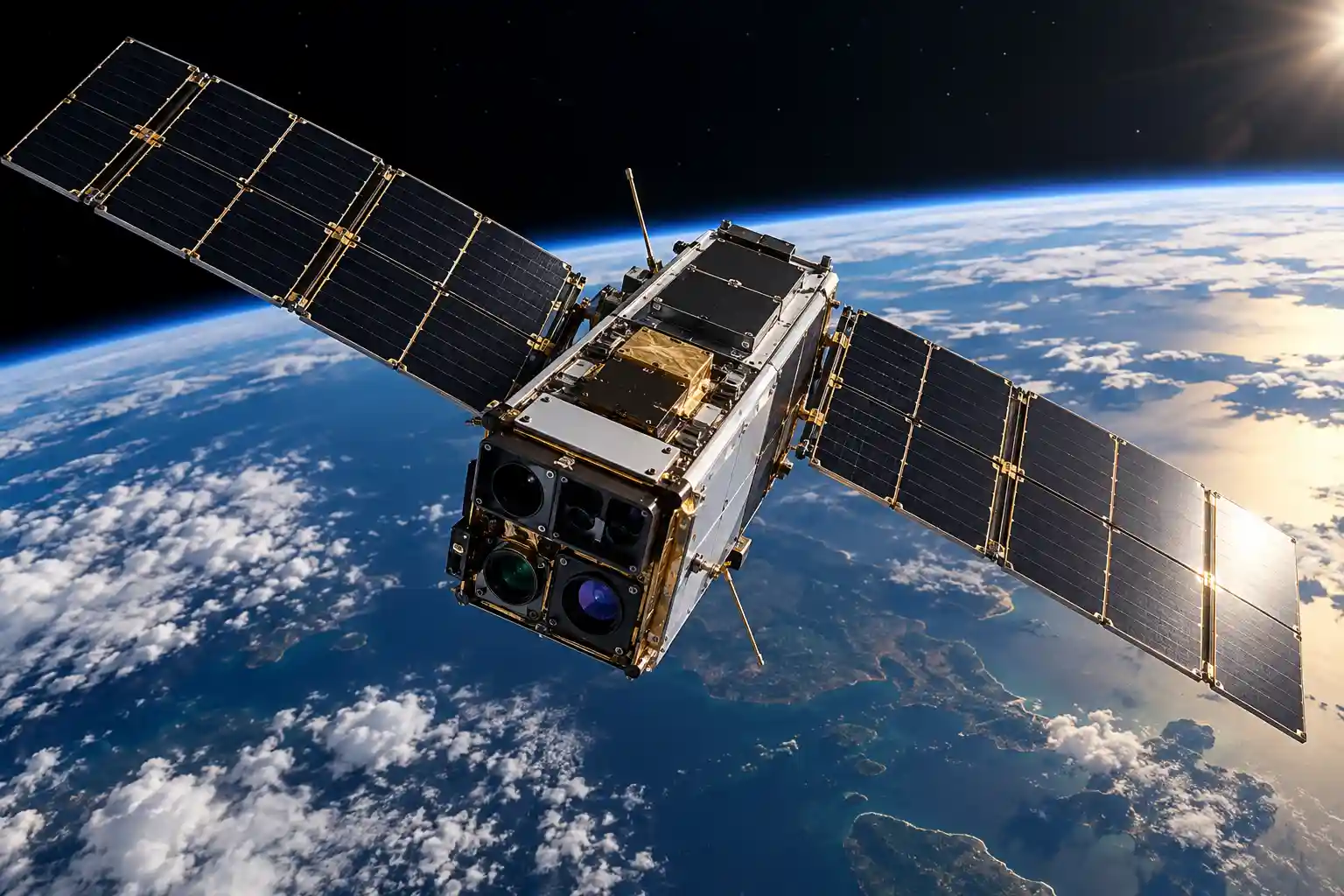
According to the company's current technical specifications, MOI-1A is a 6U-class spacecraft with a mass of approximately 14 kilograms.
Reuters described the satellite more broadly as weighing less than 50 kilograms.
The company's current published specification is the more precise figure.
Inside that compact spacecraft is an AI processing system rated at approximately 117 trillion operations per second.
The computer is based on NVIDIA's Jetson Orin NX platform and includes 16 GB of LPDDR5 memory.
MOI-1A also carries approximately 2 TB of onboard storage, with the company's architecture supporting higher configurations.
Its imaging payload is a nine-band multispectral optical system designed to capture Earth-observation data for direct onboard processing.
This is real AI inference in orbit
The word AI can be attached loosely to almost any modern satellite project.
MOI-1A's architecture is more specific.
Customers will be able to upload containerized artificial-intelligence applications to the spacecraft.
Those applications can run against imagery while the satellite passes over a selected area.
Instead of downloading every pixel before analysis begins, the satellite can identify the useful information itself.
A customer interested in agriculture might run a model detecting crop conditions.
A mining company could look for changes within a defined site.
An insurer might request analysis following floods or other natural disasters.
Supply-chain companies could potentially monitor infrastructure or activity around strategic locations.
The satellite can then transmit a much smaller analytical output rather than the complete underlying dataset.
Founder and chief executive Ronak Kumar Samantray told Reuters that the ideal early customer is an organization already paying significant amounts to download raw satellite data and then process it on Earth.
If orbital computing reduces enough of that communications and downstream processing burden, customers may be willing to pay a premium for computation in space.
TakeMe2Space says 23 customers have already signed up
The October mission is not being positioned solely as a technology demonstration.
TakeMe2Space says it has signed 23 customers for MOI-1A.
They include geographic-information-system companies and educational institutions.
Commercial applications represented among customers include agriculture, mining, supply-chain management and insurance.
U.S.-based space-data analytics company Little Place Labs is among the announced users.
That customer count is meaningful because orbital computing still has to prove an economic model, not merely a technical one.
Running an AI workload in space is technologically interesting.
A sustainable business requires customers willing to pay for the result.
The October mission therefore tests two things at once.
Can TakeMe2Space reliably execute third-party workloads in orbit?
And will customers find enough value in avoiding large raw-data transfers to keep buying orbital computing time?
The satellite is closer to edge computing than a conventional data center
The terminology around orbital data centers can become misleading.
MOI-1A is not a data center in the sense of a hyperscale facility operated by Amazon, Microsoft or Google on Earth.
A terrestrial AI data center can consume hundreds of megawatts or even more than a gigawatt.
MOI-1A operates with a power budget measured in roughly a hundred watts.
Its current specification lists approximately 120 watts of peak spacecraft power, while Samantray has described the platform to Reuters as being in roughly the 150-watt class.
Its NVIDIA Jetson hardware is an efficient edge-computing processor rather than a rack of H100, Blackwell or Rubin data-center GPUs.
The more accurate description is an orbital edge-computing platform.
That distinction does not make the mission less significant.
Edge computing is precisely what makes sense when the data source itself is moving around Earth hundreds of kilometres above the surface.
The communications bottleneck is the business opportunity
Earth-observation satellites can produce enormous amounts of imagery.
Getting all of it back to Earth is difficult.
A satellite has limited opportunities to communicate with ground stations.
Radio bandwidth is finite.
High-speed communication systems add power, mass and cost.
The spacecraft may capture useful information long before it has a suitable downlink window.
TakeMe2Space argues that this creates a fundamental inefficiency.
The company says hundreds of petabytes of Earth imagery can be captured annually while only a fraction is ultimately transmitted to the ground.
Its solution is to move part of the analytical pipeline onto the satellite.
If an image contains clouds, for example, the spacecraft can potentially identify that before consuming expensive downlink capacity.
If a customer only wants to know whether water has appeared in a particular location, the spacecraft may be able to send a compact result rather than a complete multispectral image.
The economic value of orbital compute therefore depends partly on the cost of moving bits between space and Earth.
OrbitLab turns the satellite into a programmable service
TakeMe2Space's software layer is called OrbitLab.
The concept resembles cloud computing in miniature.
A user does not have to build and launch a satellite simply to run a space-based application.
Instead, the customer can use TakeMe2Space's spacecraft as shared infrastructure.
OrbitLab allows users to select areas of interest, configure imaging parameters, test models in a development environment and ultimately deploy validated workloads to the satellite.
TakeMe2Space currently advertises live satellite tasking at around $4 per minute, with a full orbit priced at approximately $375 and discounted academic access at around $200 per orbit.
Its earlier institutional material had advertised lower introductory pricing, illustrating that the commercial model is still developing.
The larger idea is more important than the exact price.
Orbital infrastructure becomes something that can potentially be rented rather than owned.
Developers can upload their own models
The platform is not limited to AI software developed by TakeMe2Space.
Customers can deploy their own containerized applications.
That makes the satellite closer to a general-purpose computing platform than a conventional Earth-observation spacecraft running a fixed processing pipeline.
TakeMe2Space's documentation describes support for standalone applications, containerized workloads and ONNX models alongside geospatial, machine-learning, computer-vision and scientific-computing libraries.
This programmability is strategically important.
A satellite traditionally flies with a mission largely defined before launch.
Programmable orbital compute allows the useful behavior of the spacecraft to evolve after launch.
A customer may upload a new model.
An algorithm can be updated.
A different industry can use the same physical spacecraft.
The satellite becomes infrastructure rather than one application.
MOI-1A can process Earth imagery through multiple stages onboard
TakeMe2Space describes an onboard imaging pipeline extending from raw sensor information to analysis-ready outputs.
Initial processing can include calibration, dark-frame correction and flat-field correction.
Later stages can perform radiometric, atmospheric and geometric corrections.
The processing stack can then produce higher-level outputs including cloud masks, vegetation indices, water detection, change detection and other computer-vision results.
This matters because useful Earth-observation products normally require significant processing after an image reaches the ground.
Moving even part of that workflow onto the satellite can reduce the amount of infrastructure and time needed before a customer receives something actionable.
MOI-1A carries its own nine-band imager
The spacecraft is not only a computing node.
It is also an Earth-observation platform.
TakeMe2Space's current specifications describe a nine-band multispectral imager with ground resolution around nine metres and a swath of roughly 19 kilometres.
The imager allows the satellite to capture data and then immediately hand it to the onboard AI system.
This tight connection between sensor and compute is one of the central advantages of edge processing.
The data does not first have to cross a radio link or move into a terrestrial cloud region before analysis starts.
Sensor and processor travel together.
Radiation is one of the reasons ordinary computers struggle in space
Putting terrestrial computing hardware into orbit is not as simple as attaching a GPU to a satellite.
Space is a hostile electronics environment.
Radiation can corrupt memory and damage components.
Charged particles can produce single-event effects in circuitry.
Temperature cycles are severe.
Power is tightly constrained.
Repairing the hardware physically is generally impossible once the satellite is deployed.
Historically, spacecraft therefore relied heavily on specialized radiation-hardened processors that prioritized reliability over raw computing performance.
Those processors can lag commercial electronics substantially in performance.
TakeMe2Space is pursuing another approach.
It uses commercial compute hardware protected through its own radiation-mitigation technology.
RadShield is designed to make terrestrial computing hardware survive longer in orbit
TakeMe2Space calls its radiation-protection technology RadShield.
The company says its proprietary material and shielding approach can extend the usable life of otherwise terrestrial electronics operating in low Earth orbit.
The company validated the technology during its earlier orbital demonstration and says the shielding survived multiple solar events.
Its long-term commercial strategy depends heavily on this approach.
If relatively inexpensive, high-performance commercial processors can be operated reliably in space, orbital-compute systems can potentially upgrade much faster than platforms dependent exclusively on specialized radiation-hardened silicon.
That approach still carries reliability questions that longer missions will have to answer.
TakeMe2Space has already demonstrated onboard AI
MOI-1A is not the company's first hardware to reach orbit.
The MOI technical-demonstration mission launched on December 30, 2024 from Sriharikota.
TakeMe2Space says the mission successfully completed its planned orbital demonstration, executing more than 20 experiments involving onboard AI inference, sensor fusion and high-speed data handling.
The demonstration included uploading AI applications from Earth, executing them in orbit and downloading results.
That was a critical technical step.
It showed that third-party software could be moved into an orbiting computer after launch and executed remotely.
TakeMe2Space describes the hardware from that campaign as having completed hundreds of orbits successfully.
The company suffered a major setback in January
The route to MOI-1A has not been smooth.
TakeMe2Space's MOI-1 spacecraft was launched on ISRO's PSLV-C62 mission on January 12, 2026.
The launch vehicle experienced a third-stage anomaly.
MOI-1 was lost with the mission.
TakeMe2Space says its own spacecraft systems remained nominal until the launch failure.
The loss delayed the company's operational orbital-compute plans but did not invalidate the underlying onboard-computing technology previously demonstrated in orbit.
MOI-1A is effectively the replacement mission intended to move the commercial programme forward.
SpaceX provides the next route to orbit
MOI-1A is switching launch providers.
The spacecraft is manifested on SpaceX's Transporter-18 rideshare mission from California.
SpaceX's Transporter programme aggregates numerous small satellites on one Falcon 9 mission, reducing the cost of reaching orbit for customers that do not need an entire rocket.
As of September 28, SpaceX lists Transporter-18 for October 1 from Vandenberg Space Force Base.
Launch schedules can still change because of weather, technical issues or range conditions.
That means October 1 should be described as the current scheduled date rather than an irreversible deadline.
Orbital AI is becoming a real technology category
TakeMe2Space is not alone in moving more compute into space.
NVIDIA formally expanded its focus on space computing in March 2026, promoting Jetson Orin, IGX Thor and its Space-1 Vera Rubin platform for applications ranging from autonomous spacecraft to orbital data centers.
Companies including Starcloud, Axiom Space, Kepler Communications, Planet Labs and others are experimenting with increasingly capable space-based computing systems.
The broader industry thesis is that spacecraft should process more information locally instead of acting as simple remote sensors.
For autonomous satellites, that can mean navigation and decision-making.
For Earth observation, it means converting imagery into intelligence before downlink.
For future orbital data centers, proponents imagine something much larger: clusters of high-performance computers operating outside Earth.
Starcloud has already put a full H100 into orbit
The global context is important when describing MOI-1A's novelty.
U.S.-based Starcloud launched a satellite carrying an NVIDIA H100 GPU in November 2025.
The company later used that system for AI workloads including running language models and training a small neural network in orbit.
That means MOI-1A is not the world's first powerful AI computer in space.
Its significance lies elsewhere.
TakeMe2Space is trying to commercialize a shared orbital-computing service from India and connect onboard computing directly to Earth-observation customers.
Its architecture is currently far smaller than Starcloud's data-center-grade GPU experiment.
But the lower-power edge approach could be commercially useful much sooner for applications where the data is already being generated in orbit.
The first business case is processing satellite data, not replacing terrestrial cloud computing
The idea of orbital data centers can sound as though companies intend to move ordinary internet computing into space immediately.
That is not TakeMe2Space's near-term business.
For most ordinary computing workloads, terrestrial data centers remain dramatically easier to build, maintain and connect.
The immediate advantage of orbital compute appears when the source data itself is already in orbit.
Earth imagery is a good example.
Sending it to Earth merely to analyze it introduces communications cost and delay.
Processing it next to the camera is an edge-computing problem.
That is the market MOI-1A is designed to test.
The company also sees an orbital data-storage market
TakeMe2Space has another longer-term concept: data storage in orbit.
Samantray told Reuters that the company is exploring cold-storage applications for customers including financial-services and defence organizations.
The argument is that a physically separate orbital copy could provide another layer of resilience beyond terrestrial data centers.
This remains much less proven commercially than Earth-observation processing.
Data stored in orbit still needs communication links, security, redundancy and replacement strategies as satellites age.
A terrestrial tape archive is vastly cheaper to access and maintain.
But highly sensitive organizations may value physical separation for specific backup use cases.
The six-satellite constellation is the next scale step
TakeMe2Space says it intends to move from individual spacecraft toward a six-satellite constellation.
Its published plan targets complete daily global coverage with orbital computing by the fourth quarter of 2027.
A constellation changes the product materially.
One satellite can only observe a particular location when its orbit passes overhead.
Multiple satellites reduce the time between opportunities.
They also create more available computing capacity and potentially allow workloads to be distributed across different spacecraft.
The company raised $5 million in early 2026 in a round led by Chiratae Ventures, with participation from Unicorn India Ventures, Artha Venture Fund and SeaFund, partly to finance this transition from a single-satellite system toward a networked platform.
TakeMe2Space has raised about $5 million in its major institutional round
Chiratae Ventures announced its investment in January 2026 and described TakeMe2Space as building a cloud-computing layer for orbit.
TakeMe2Space itself said the $5 million round followed a ₹5 crore pre-seed round led by SeaFund.
The company has said the capital would support its constellation, optical communications and expansion of orbital-compute capacity.
That remains modest funding compared with the hundreds of millions of dollars being raised by some U.S. orbital-data-center startups.
It also forces TakeMe2Space toward a significantly smaller, capital-efficient architecture.
The much bigger orbital data-center experiment comes in 2028
The company's ambitions extend considerably beyond MOI-1A.
TakeMe2Space says it has signed launch arrangements for a 2028 mission intended to test a networked orbital data center using two much larger spacecraft.
Each planned satellite is expected to weigh around 100 kilograms.
Founder Ronak Samantray told The Times of India that each would carry 10 NVIDIA Thor GPUs, approximately 100 TB of storage and generate around 1.5 kilowatts of power.
The satellites are expected to use optical inter-satellite links so the pair can exchange data and computational workloads directly in orbit.
That is the point at which the term networked orbital data center becomes more technically meaningful.
Instead of one computer attached to one sensor, multiple spacecraft begin behaving like elements of a distributed computing cluster.
Optical links could turn separate satellites into one computing network
This is one of the most important technological steps in the company's roadmap.
If satellites have to route every exchange through Earth, they are not truly operating like a distributed data center.
Optical inter-satellite communication allows large amounts of information to move directly between spacecraft using laser links.
One satellite could capture information.
Another could have spare compute capacity.
A third might be positioned closer to a suitable ground station.
In principle, a network could route data and workloads between nodes before returning the final result to Earth.
The concept resembles terrestrial distributed computing, but every server is moving around the planet at orbital velocity.
That makes network scheduling, pointing, synchronization and reliability significantly more complicated.
The planned 2028 mission would use much more powerful NVIDIA Thor hardware
TakeMe2Space's current MOI-1A uses Jetson Orin NX, a processor designed for efficient edge AI.
The larger generation planned for 2028 would move to NVIDIA Thor-class compute.
This aligns with the broader evolution of NVIDIA's space-computing strategy.
In March, NVIDIA identified Jetson Orin and Thor platforms as part of a spectrum of accelerated computing hardware for orbital workloads.
Using higher-performance processors could allow future TakeMe2Space spacecraft to execute more complex models and serve multiple customers simultaneously.
But higher compute creates an immediate consequence.
It requires more power.
And almost every watt consumed by electronics eventually becomes heat that has to be rejected into space.
Thermal management is much harder than orbital-data-center marketing sometimes suggests
Space is cold in a colloquial sense, but vacuum is not a free cooling system.
On Earth, data centers can transfer heat into air or water.
There is essentially no surrounding fluid in orbit to carry heat away through convection.
A spacecraft must largely reject waste heat through thermal radiation.
That can require substantial radiator area as computing power increases.
This becomes one of the fundamental engineering limits on very large orbital data centers.
Proponents frequently emphasize abundant solar energy in orbit.
Solar power is indeed attractive.
But converting that electricity into computation also creates heat.
Gigawatt-scale orbital computing would require enormous power-generation and thermal-control structures in addition to processors.
TakeMe2Space's current hundred-watt-class mission is far removed from that scale.
Radiation and replacement economics matter just as much
Commercial data centers on Earth can replace failed servers continuously.
An orbital data center cannot send a technician down the aisle to replace a GPU.
Hardware either needs extreme reliability or the network must be designed around failures.
Space radiation increases the challenge.
Launch costs add another economic layer.
Even if solar electricity in orbit is abundant, every kilogram of compute, radiator, solar array, battery and structural hardware has to reach orbit first.
This is why falling launch costs are central to the orbital-data-center thesis.
Without inexpensive, high-frequency launch, terrestrial data centers retain an overwhelming logistics advantage.
TakeMe2Space is pursuing a very different scale from SpaceX
The orbital-compute market now spans dramatically different visions.
TakeMe2Space begins with small satellites and Earth-observation edge computing.
Starcloud has demonstrated a full data-center-class NVIDIA H100 in orbit and is raising large amounts of capital toward much larger systems.
SpaceX has discussed far more ambitious future orbital AI infrastructure tied to its launch and satellite businesses.
The common assumption is that space-based energy availability and direct access to orbital data may eventually justify moving more computation off Earth.
The economics remain unproven at large scale.
India's advantage may be a lower-cost engineering model
TakeMe2Space says most of the satellite subsystems it flies are designed and manufactured internally in India.
The company sources some key components externally, including semiconductor chips, solar cells and propulsion.
Its strategy is to combine comparatively inexpensive satellite manufacturing with commercial computing hardware rather than build extremely expensive bespoke spacecraft.
That reflects a broader characteristic of India's private space sector.
Startups increasingly compete on engineering cost as well as technical capability.
If orbital computing ultimately becomes a significant market, low spacecraft cost could matter nearly as much as raw processing performance.
The October mission therefore matters beyond one small satellite
MOI-1A will not move the world's data centers into orbit.
Its computing power is tiny beside terrestrial AI clusters.
Its current business model remains early.
The number of customers actively paying at scale has not yet been demonstrated publicly.
And the economic advantage of orbital compute will vary significantly by workload.
But those limitations are exactly why the mission is useful.
The orbital-computing industry does not need another theoretical presentation.
It needs operational data.
How reliably can commercial AI hardware run in orbit?
How frequently can customers upload new workloads?
How much raw downlink traffic can onboard processing genuinely eliminate?
How much are customers willing to pay for faster answers?
How does radiation affect electronics over longer missions?
And can the economics improve as the constellation grows?
MOI-1A is designed to start answering those questions.
The next cloud may be partly above the clouds
Cloud computing transformed terrestrial technology by allowing organizations to rent computing infrastructure instead of owning every server themselves.
TakeMe2Space is attempting a similar abstraction in orbit.
Customers do not necessarily want satellites.
They want information about crops, mines, infrastructure, weather events or other activity on Earth.
If the raw data already exists hundreds of kilometres above the planet, processing it there may sometimes be more efficient than transmitting everything first.
That is the immediate opportunity.
The larger vision is much more ambitious: fleets of networked satellites sharing storage and computational workloads like servers in a distributed data center.
TakeMe2Space is still several engineering generations away from that vision.
Its 2028 networked mission will be far more important to that thesis than the current small satellite.
But every computing architecture begins with a smaller node.
For TakeMe2Space, MOI-1A is that node.
If the October mission works as intended, the company will have moved beyond proving that AI can run in space.
It will begin testing whether orbital computing can become something customers routinely buy.
Reader questions
Frequently asked questions
What is TakeMe2Space launching?
TakeMe2Space plans to launch MOI-1A, an orbital edge-computing and Earth-observation satellite capable of running AI workloads directly in low Earth orbit.
When will MOI-1A launch?
It is currently scheduled for October 1, 2026 aboard SpaceX's Transporter-18 mission. Launch schedules can change.
Which rocket will launch MOI-1A?
MOI-1A is scheduled to fly aboard a SpaceX Falcon 9 on the Transporter-18 rideshare mission.
What AI processor does MOI-1A use?
TakeMe2Space says the spacecraft uses an NVIDIA Jetson Orin NX-based AI processing system.
How powerful is MOI-1A?
The company's current specification lists approximately 117 TOPS of AI compute, 16 GB of LPDDR5 memory and 2 TB of onboard storage.
How much does MOI-1A weigh?
TakeMe2Space's current technical page lists the 6U spacecraft at approximately 14 kilograms. Reuters described it more broadly as a sub-50 kg satellite.
What does orbital computing mean?
Orbital computing means performing data processing directly aboard a satellite rather than transmitting all raw information to Earth before analysis.
Why process satellite data in orbit?
Onboard processing can reduce the amount of data that needs to be transmitted, decrease latency and allow satellites to send useful insights rather than complete raw datasets.
Can customers run their own AI models on MOI-1A?
Yes. TakeMe2Space says customers can deploy containerized AI workloads through its OrbitLab platform.
How many customers has TakeMe2Space signed?
The company says 23 customers have signed up for the MOI-1A mission.
Which industries are using the satellite?
Reported commercial users include companies working in agriculture, mining, supply-chain management, insurance and geospatial information.
Is MOI-1A really a data center in space?
Not in the conventional hyperscale sense. MOI-1A is better described as an orbital edge-computing satellite. TakeMe2Space plans much larger networked systems in later generations.
Did TakeMe2Space already run AI in space?
Yes. Its MOI-TD mission launched in December 2024 and the company says it successfully demonstrated onboard AI inference and uploading software from Earth.
What happened to MOI-1?
MOI-1 was lost on January 12, 2026 when the PSLV-C62 launch vehicle experienced a third-stage anomaly. TakeMe2Space says its satellite systems were nominal before the launch failure.
What is OrbitLab?
OrbitLab is TakeMe2Space's software platform through which developers and organizations can test applications, task satellites and deploy workloads to orbital compute hardware.
How much does orbital computing cost on OrbitLab?
TakeMe2Space currently advertises live satellite access at approximately $4 per minute, with a full orbit around $375 and lower academic pricing.
Is TakeMe2Space building more satellites?
Yes. The company plans a multi-satellite constellation and says six onboard-compute spacecraft are intended to provide daily global Earth-observation coverage.
What is TakeMe2Space planning for 2028?
The company plans a networked orbital data-center demonstration using two larger satellites connected through optical inter-satellite links and equipped with substantially more computing and storage capacity.
What will the 2028 satellites contain?
TakeMe2Space has described approximately 100 kg spacecraft carrying multiple NVIDIA Thor GPUs, around 100 TB of storage each and roughly 1.5 kW of power.
Are orbital data centers already commercially proven?
No. Onboard AI processing is technically demonstrated, but large networked orbital data centers remain an emerging and economically unproven infrastructure model.
Nexuswild welcomes factual corrections. Email contact@nexuswild.com with evidence and the article URL.